Dahab lagoon, Egypt
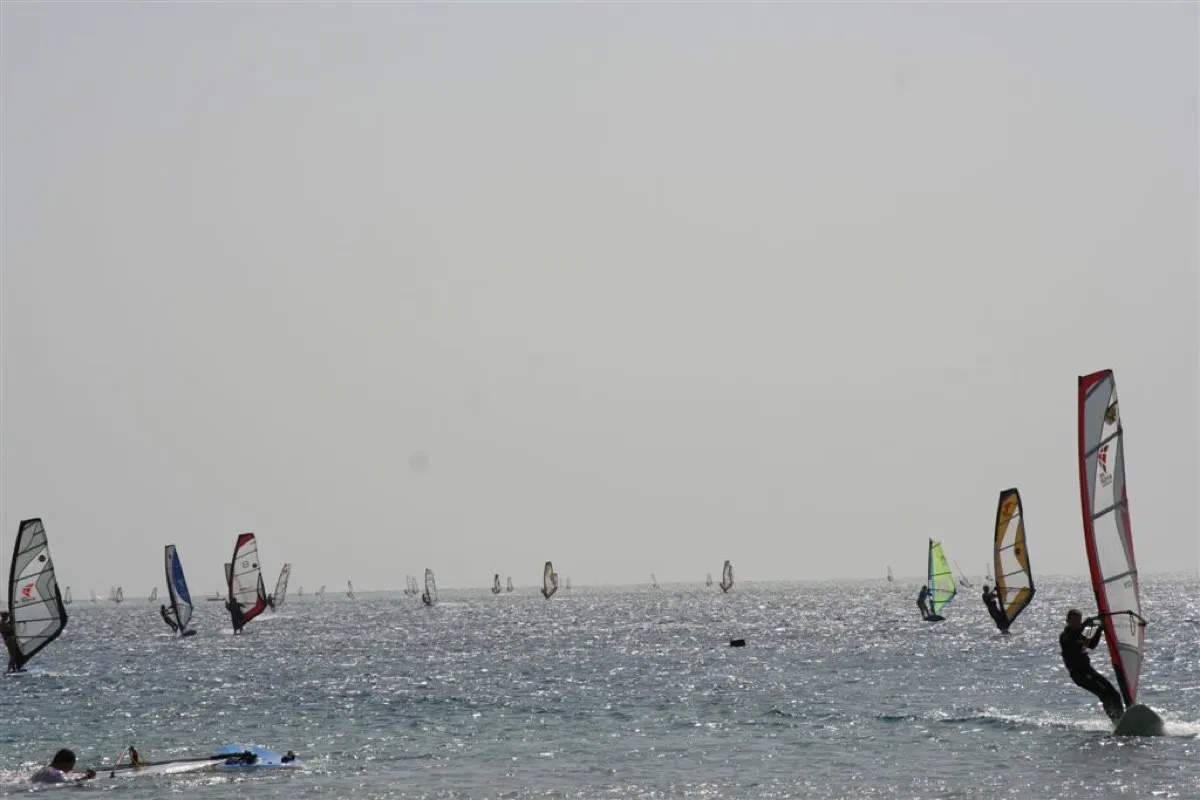
| Coordinates | Lagoon ~28.50°N, 34.51°E, Dahab, Sinai |
| Wind | N/NW funneled down the Gulf of Aqaba, partly thermal; 15–25 kt, ~300 windy days/yr |
| Water | 2.5 km lagoon behind a sandspit; knee-to-hip deep, very flat, sandy; tide-dependent |
| Relaunch room | Wide, shallow standing-depth lagoon; slippery in parts at low tide |
| Rescue | Center lifeboats and walkie-talkie safety (Harry Nass, ION Club, Vetratoria) |
| Rules | Zoned areas; no kite in Baby Bay; radio-rescue advised for outer wave zones |
| Level | Beginner to advanced; lagoon ideal for learning |
Dahab sits on the Sinai coast of the Gulf of Aqaba, about 90 minutes from Sharm El Sheikh, and its lagoon is one of the cheapest reliable flat-water setups anywhere. The lagoon runs about 2.5 km, separated from the open sea by a sandspit, and it is knee-to-hip deep, very flat, and sandy. Wind is N/NW, funneled down the gulf with a venturi effect and partly thermal, running 15–25 kt across roughly 300 windy days a year. That is a strong flat-water profile: contained, shallow, warm, and windy.
Two honest caveats before the read goes further. First, no documented parawing sessions are on record at Dahab — the suitability here is inferred from the resident kite and wing centers and from the lagoon itself, not from parawing riding I can cite. Second, the same source that praises Dahab flags it as an offshore-wind spot, and that changes the safety math for a stashed wing.
The offshore-wind problem
The prevailing N/NW blows partly offshore. For a parawing rider this is the decisive factor: if you stash the wing and end up swimming, you drift away from the beach and out toward open water, and a packed wing sits low and nearly invisible. The centers — Harry Nass, ION Club/Club Mistral, Vetratoria (a licensed wingfoil school with rescue boats) — run lifeboats and walkie-talkie safety systems for exactly this reason. Ride inside the marked lagoon, buy the center rescue cover, rehearse self-rescue and drift, and carry a backup means of visibility. Beyond the marked reefs is a wave zone; radio-rescue affiliation is advised before you go there.
Tide and zoning
The lagoon is tide-dependent. It is flat and shallow, but slippery in parts at low tide, and low water leaves too little depth to clear a foil mast — ride mid-tide. The area is zoned: a kite lagoon separated from windsurf zones 1–3, and no kite in Baby Bay. The Blue Lagoon, 20 km north, is stronger and cleaner at 15–30 kt if you want more power.
Season
March–November overall, with September–December bringing the stronger 18–25 kt winds that kick in mid-morning. Avoid June–August, when heat hits 45–50°C and the wind weakens. Lodging spans Bedouin camps to 4-star resorts, and the whole trip is cheap by flat-water-destination standards.
For warm-water flat alternatives with onshore rescue geometry, compare the flat-water spots hub, and size for the 15–25 kt range with the parawing size calculator.
FAQ
Is Dahab lagoon good for parawing?
On paper it is excellent — a 2.5 km flat, knee-to-hip-deep, contained lagoon with reliable wind. But no documented parawing sessions confirm it; the read is inferred from the kite and wing scene, and the offshore wind means rescue cover is essential.
Why is the offshore wind a problem?
The prevailing N/NW blows partly offshore, so anyone who ends up swimming drifts away from the beach and toward open water. A stashed parawing is nearly invisible, which is why the centers run lifeboats and radio safety and why you should affiliate with rescue.
Does the tide matter?
Yes. The lagoon is tide-dependent — knee-to-hip deep and very flat, but slippery in parts at low tide, and low water leaves too little depth to clear a foil mast. Ride mid-tide.
When is the best time to go?
March–November overall, with September–December bringing the stronger 18–25 kt winds that kick in mid-morning. Avoid June–August: 45–50°C heat and weaker wind.