Big Bay, South Africa
| Coordinates | -33.79, 18.46 (approx.) |
| Wind | Side-shore SE ('Cape Doctor'), often 25-40 kt |
| Water | Beach/reef; small-to-medium rolling lefts and rights |
| Relaunch room | Rock-sheltered left side for easy access and smoother water |
| Rescue | Strong Blouberg-area wing/kite community on hand |
| Rules | Shared with a busy wing/kite scene; yield to surfers on the waves |
| Level | Advanced |
What Big Bay is
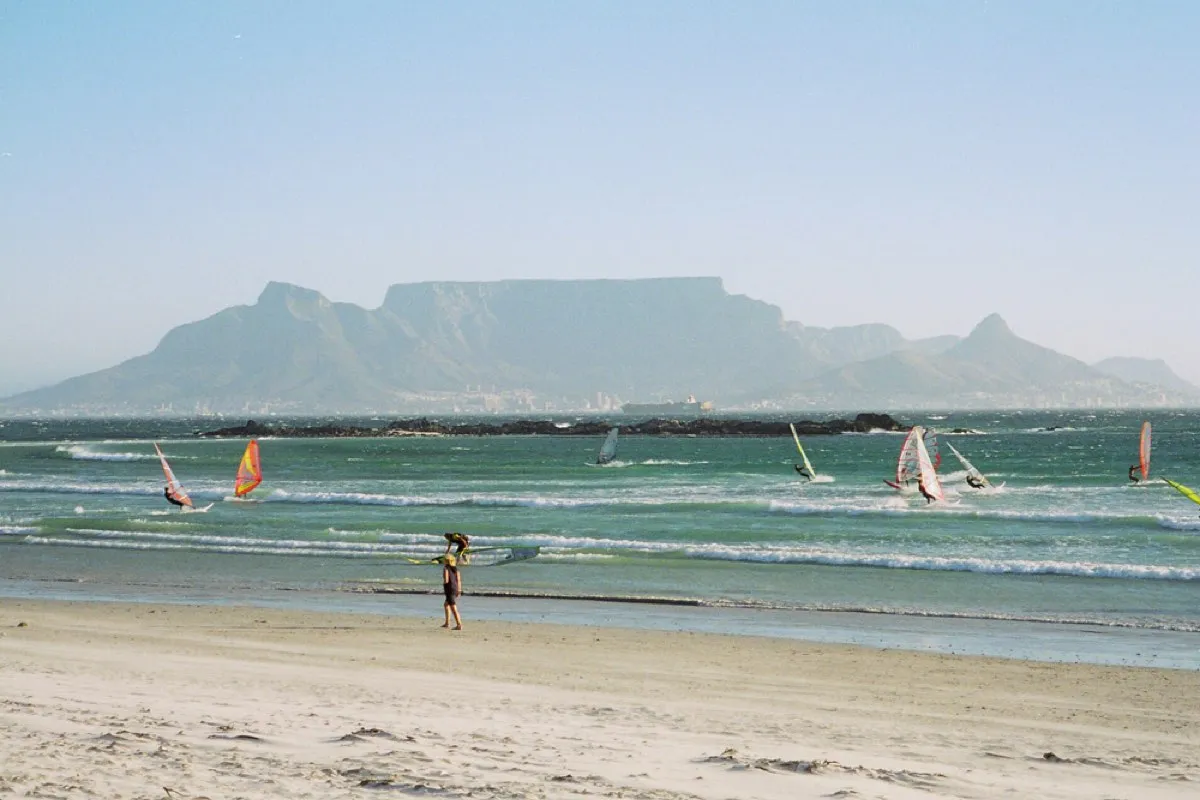
Big Bay, in the Blouberg area north of Cape Town, is a wingfoiling staple. The left side is partially sheltered by rocks, giving easy access and smoother water, while the north side of the rocks holds nice small-to-medium lefts and rights. It works best in S/SE winds with a small-to-medium swell — the classic Cape Town summer setup.
Is this a documented parawing spot?
Not yet. Documented parawing riding at Big Bay is not established, and this profile is inferred from the wing and kite record at the same break rather than from parawing sessions. That said, of the Cape Town options it is the one whose fundamentals map most cleanly onto a parawing, which is why the analysis rates it the friendliest local choice.
Why the analysis is positive
Two things carry it. First, the wind: the SE “Cape Doctor” is side-shore and strong, often 25-40 knots from November to March, which gives a clean workflow and an easy return to the beach — the opposite of a side-offshore reef trap. Second, the rock-sheltered left provides a forgiving launch and smoother water to sort yourself out. Small-to-medium rolling waves are far more foil-friendly than hollow reef barrels.
The honest cautions
The SE can be gusty over the point, so err toward a size you can hold down — cross-check with the parawing size calculator. The open beaches carry shorebreak and shallow-entry risk, the Atlantic here is genuinely cold, and there is shark presence in the broader region. None of these is unique to parawinging, but all of them reward respect. Keep your self-rescue and drift sharp regardless.
The scene
The strong Blouberg-area wing and kite community is an asset: busy water means eyes on you, but it also means you must fit into an established line-up. Yield to surfers on the waves and to riders already committed to a line. Compare Big Bay against other advanced wave options on the waves hub or filter by conditions with the spot finder.
FAQ
Can you parawing at Big Bay?
Documented parawing riding at Big Bay is not established, but by analysis it is the most parawing-friendly spot in Cape Town: side-shore SE wind, a sheltered left side for easy access, and small-to-medium rolling waves. It grades advanced within the wave-parawing band.
What wind does Big Bay need?
The SE 'Cape Doctor' is the working wind — side-shore and strong, often 25 to 40 knots, from November to March. It can be gusty over the point, so give yourself margin on gear size.
Is Big Bay good for less-experienced riders?
It is the friendlier Cape Town option, but wave parawinging is advanced everywhere. The rock-sheltered left gives smoother water and easy access; the open beaches have shorebreak and shallow entry, and the Atlantic is cold.
What are the main hazards?
Gusty wind over the point, shorebreak and shallow entry at the open beaches, cold Atlantic water, and sharks in the broader region. The upside is a strong Blouberg-area wing and kite community nearby.