Flag Beach, Spain
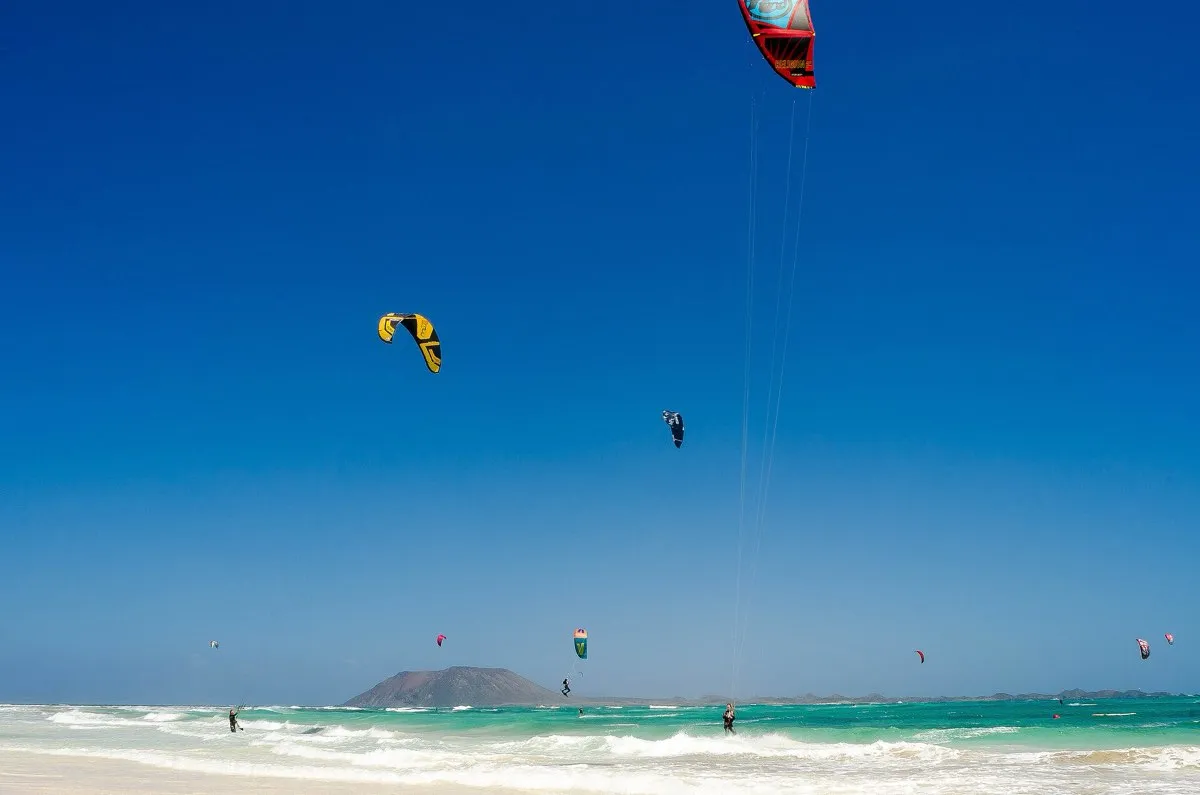
| Coordinates | ≈ 28.71, -13.83 — Corralejo / Flag Beach, north-shore Fuerteventura |
| Wind | Side-shore NE-NW trades; the wind window runs roughly April–August |
| Water | Rocks and reef, especially at low tide — enter at high tide and wear booties |
| Rules | Shared lineups with surfers — give priority; dense IKO/VDWS school traffic around Corralejo |
| Level | Advanced |
Flag Beach is the wide bay just south of Corralejo on the north shore of Fuerteventura. It is one of the busiest wind-sports beaches in the Canaries, and it earns a place on any wave-parawing shortlist for the same reasons the wingers and kiters love it: side-shore NE-NW trades and a run of rolling waves rather than a single hollow reef barrel.
Be clear about the provenance, though. Documented parawing use at Flag Beach is not established. What follows is an assessment inferred from the area’s wing, kite and prone-foil record, not a log of proven parawing sessions. Nothing here should be read as “riders have parawinged this and confirmed it.” If you go, you may be putting in some of the first sessions.
Why it reads well for a parawing
The trades here are side-shore, which is the friendliest wind angle for a wave parawing: you can hold a line along the swell, and if you drop off foil you are not being blown straight out to sea or straight onto the rocks. The wind window runs roughly April through August. Waves are the softer, rolling kind on the north shore, and neighbouring Rocky Point and Glass Beach add side-to-side-off wave options within a short drive, so you can chase the angle that matches the day.
What holds it back
Two things. First, the bottom is rocky and reefy, and it bites hardest at low tide — the standing advice is to enter at high tide and wear booties. That matters more for a parawing than for a kite, because your recovery involves stashing the wing and swimming your foil, and you do not want to do that over exposed rock. Second, the lineups are shared. Surfers get priority, and Corralejo’s dense IKO and VDWS school scene means a lot of bodies and lines on the water. Both push this into advanced-rider territory.
How to approach it
Come in the wind season, ride the higher tide, and stay off the shallow rock. Be genuinely solid on self-rescue and drift before you commit to a session away from clean water, and size conservatively — a size calculator helps. Until someone logs real parawing time here, treat the whole assessment as a hypothesis about a promising side-shore venue, not a verdict.
FAQ
Is Flag Beach a good parawing spot?
On paper, yes for advanced riders: it has side-shore NE-NW trades and rolling waves, which is the workflow a parawing wants. But there are no documented parawing sessions here — the read is inferred from wing and kite use in the same area, not proven parawing riding.
When is the wind season at Flag Beach?
The wind window runs roughly April through August. Bigger waves tend to arrive on winter swell, so the strong-wind months and the biggest-wave months do not fully overlap.
What are the main hazards at Flag Beach?
Rocks and reef, worst at low tide — enter at high tide and wear booties. The lineups are also shared with surfers, who get priority, and Corralejo has heavy school traffic on the water.
Are there nearby alternatives to Flag Beach?
Rocky Point and Glass Beach nearby deliver side-to-side-off wave conditions. The whole north shore of Fuerteventura offers side-shore trades and rolling wave options within a short drive.