Swell City, USA
| Wind | Thermal westerlies blowing against the river current, strongest on summer afternoons; most summer days are a 3–4 m parawing day |
| Water | Cold freshwater with strong current, coldest in spring/early season from snowmelt; a wetsuit is normal |
| Relaunch room | Short 5–10 km laps with dozens of launches along the river, but bail points are often on the far bank and wind drops and rebuilds mid-run |
| Rescue | No formal on-water rescue; the Big Winds shuttle mandates leash, hydration pack and PFD, with a 4-rider minimum |
| Rules | Paid parking at several launches; the Washington side needs a Discover Pass ($11.50/day, $45/yr from Oct 2025); heavy mixed-craft traffic near the Hatch |
| Level | Intermediate; the natural stepping stone before the full Viento to Hood River run |
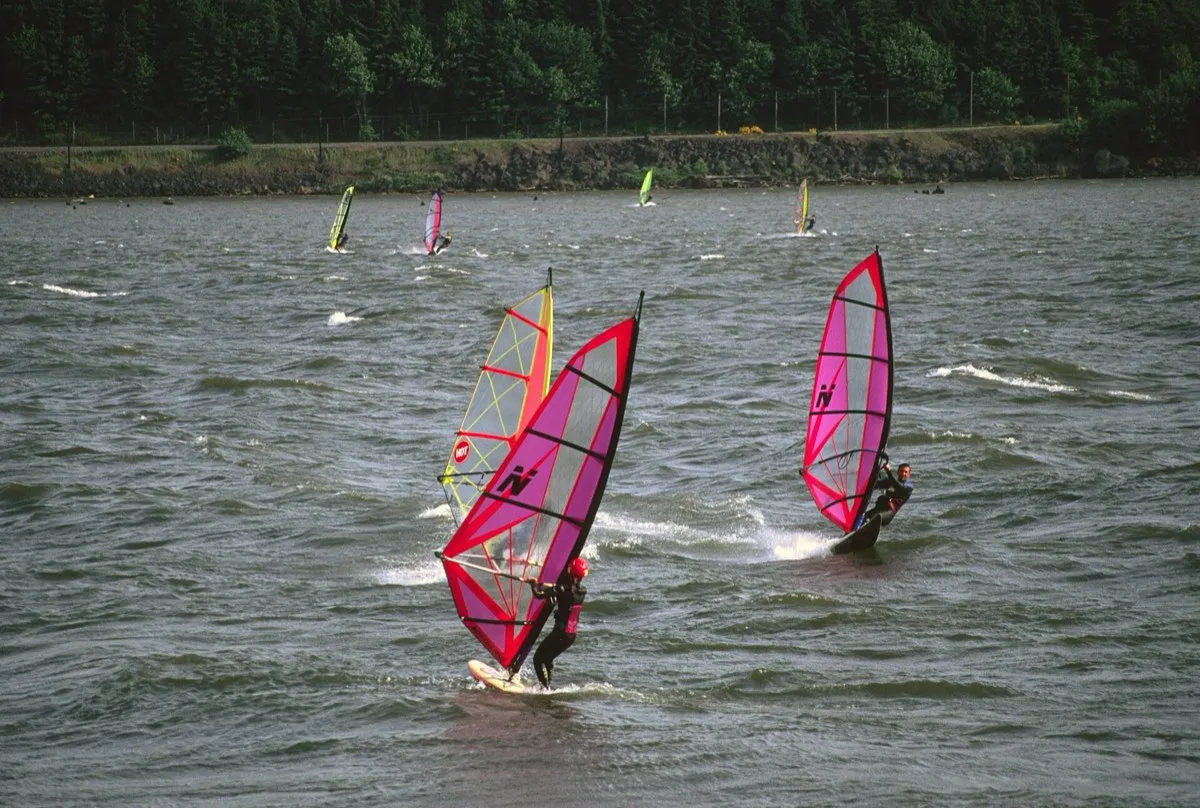
Swell City to the Hatch is the Columbia Gorge in miniature: the same tightly-spaced, wind-against-current bumps as the marquee lines, packed into a 5–10 km lap you can run again and again. That repeatability is the whole point. The Gorge is arguably the deepest genuine parawing-downwind hub outside Hawaii, with an explicit parawing scene rather than a wing scene that tolerates parawings, and Swell City is where you put in the volume before you commit to the long stuff. See the full downwind hub for how it sits in the wider menu.
Why the bumps stack up
The Gorge has a mechanism most venues lack. Thermal westerlies blow against the river current, and the opposing flow stacks the wind swell into tight, groomed bumps far bigger than the wind alone would build. Strong wind arrives most summer afternoons, June through August. What you ride is a conveyor of short-period bumps: tighter spacing than Hawaiian ocean swell, so your foil and your legs work differently here. Learning to hold glide through the holes and stay upwind is the skill this venue teaches fastest.
The trade-off: cold water and current
The water is the catch. Cold freshwater, coldest in spring and early season when snowmelt is running, and the same current that grooms the bumps becomes a genuine hazard the moment you are swimming. A wetsuit is normal kit even in summer. Bail points exist along the run, but often on the far bank, so a dead-wind moment can leave you either crossing the river or self-recovering and riding out. Swimming across a shipping channel is not a plan.
Shuttles and access
This is the easiest shuttling anywhere: dozens of launches line the river. Big Winds runs a dedicated downwind shuttle and its rules make a sensible personal minimum even when you self-shuttle: leash, hydration pack, PFD, and a 4-rider minimum group. Budget for access fees, too. Several launches require paid parking, and Washington-side launches such as the Hatch need a Discover Pass, $11.50 a day or $45 a year as of October 2025.
Gear
Small gear. Most summer days here are a 3–4 m parawing day, so bring the small end of your quiver and a second size for the holes; the wind drops and rebuilds mid-run even on a short lap. High-aspect foils are the local standard. One uniquely Gorge feature: the wind gradient runs along the river, so you can drive east for more wind or west for less and almost always find your conditions. Dial in your sizes with the parawing size calculator, and see what to look for in a small-wind wing in the parawings gear guide.
The scene
As deep a downwind culture as North America has, and explicitly parawing-friendly. The Gorge Challenge runs a 7-mile Downwind and a 14-mile Double Downwind with a dedicated Wingfoil/Parawing start, one of the few races anywhere where parawing is a named division. Big Winds, Doug’s, Windance and the local GoFoil crews cover gear and lessons. When Swell City laps feel automatic, the full Viento line and the wider spots directory are the next step.
FAQ
How long is the Swell City to the Hatch run?
Roughly 5–10 km, depending on your exact put-in and take-out. It is one of the shorter shuttle runs in the Columbia Gorge, sitting below the classic 12 km Viento to Hood River line, which makes it ideal for repeatable training laps.
Is Swell City good for learning parawing downwind?
It is the right stepping stone once you can already stash and redeploy in flat water. The Gorge is not a true-beginner venue because of strong afternoon wind, cold freshwater and current, but the short Swell City laps let you build up before committing to the full run.
What size parawing for Swell City?
Most summer days in the Gorge are a 3–4 m day. This is a small-gear, strong-wind venue. Carry a second size, because the wind drops and rebuilds mid-run even on the shorter laps, and you can drive east for more wind or west for less.
Do I need a pass to launch on the Washington side?
Several launches now require paid parking, and Washington-side launches like the Hatch need a Discover Pass: $11.50 a day or $45 a year as of October 2025. Budget for access fees before you go.