Cumbuco to Jericoacoara safari, Brazil
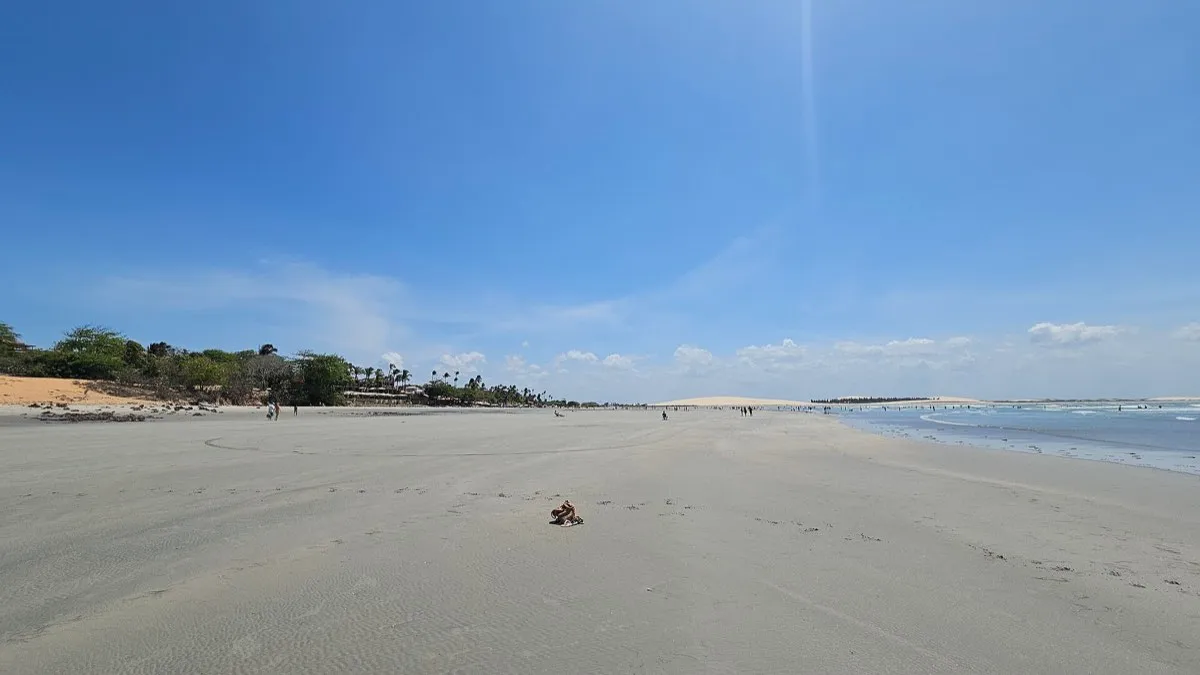
| Wind | SE trades; Cumbuco ~15–25 kt, Jericoacoara/Preá often 30+ kt; side-onshore |
| Water | 25–28 °C |
| Relaunch room | Side-onshore wind and waves push you back toward the beach |
| Rescue | Guides in the water plus 4×4 chase vehicle; boats where roads end |
| Rules | Operator-run safaris (accommodation, transfers, support included) |
| Level | Advanced multi-day (medium-advanced minimum) |
What is the Cumbuco to Jericoacoara safari?
The Cumbuco-to-Jericoacoara safari is a multi-day, operator-run point-to-point downwind trip along the northeast coast of Ceará, Brazil, covering roughly 250–1,000 km of coastline in daily legs of 30–60 km. It runs on relentless side-onshore SE trades that strengthen the further northwest you travel. Documented parawing use here is not established — the proxy record is kite and wing safari — but the endless fetch, warm water and daily support format make it a strong candidate for downwind glide. This is an advanced, guided venue, not a place to learn.
The classic itinerary runs Cumbuco → Taíba → Paracuru → Guajiru → Icaraizinho → Ilha do Guajiru → Jericoacoara, with possible extensions to Barra Grande and Atins. Fortaleza is the airport hub — Cumbuco sits about 30 km away, while Jericoacoara is roughly a five-hour drive.
What are the wind and water like?
The SE trades are the whole point: they blow side-onshore, day after day, and build in strength as you head northwest. Cumbuco typically sees around 15–25 kt, while Jericoacoara and Preá regularly deliver 30+ kt with big waves. Water temperature stays a forgiving 25–28 °C across the season. The window runs roughly August through February, peaking from around July/August into January.
Because the wind is side-onshore, both wind and waves tend to push a downed rider back toward the beach rather than out to sea — a meaningful safety margin on a multi-day trip. Operators such as Downwind Kite Safari, Freeride Kitesurf and Surfin Sem Fim run 4×4 Hilux support on the beach, boats where roads don’t reach, in-water guides, and included accommodation and transfers.
Is it suitable for parawing?
Honestly: it should be, but nobody has published a parawing record here yet. The documented downwinding is kite and wing — The Foiling Magazine covered wing-surf downwinders on the short, famous Rancho do Peixe → Vila Kalango leg near Jeri. Everything that makes this coast work for a kite safari — the steady side-onshore fetch, the daily-leg conveyor belt, the warm water — also suits a parawing. But an inference is not a record.
If you go, treat it as pioneering. Bring a range of parawing sizes so you can step down as the wind builds northwest, use the parawing size calculator to plan that spread, and drill self-rescue and drift before you commit — some legs cross river mouths and mangroves the chase vehicle cannot follow. Compare it against the rest of the downwind spots before booking.
FAQ
Can you parawing the Cumbuco to Jericoacoara safari?
It is plausible but not documented. The published record for these safaris is kite and wing foil. The conditions — steady side-onshore SE trades, warm water and daily support — suit parawing, but you would be among the first, so plan conservatively and lean on the guides.
How long are the daily legs?
Typically 30–60 km per day, strung across a classic itinerary from Cumbuco through Taíba, Paracuru, Guajiru, Icaraizinho and Ilha do Guajiru to Jericoacoara, with possible extensions to Barra Grande and Atins.
When is the season?
Roughly August to February, with the peak from around July/August through January. The SE trades are most relentless in this window.
Is it beginner-friendly?
No. It is an advanced multi-day trip requiring solid self-rescue and comfort in strong wind and waves — Jericoacoara and Preá regularly see 30+ kt with big waves. Some legs the support 4×4 cannot follow across river mouths and mangroves.