Maliko Run, USA
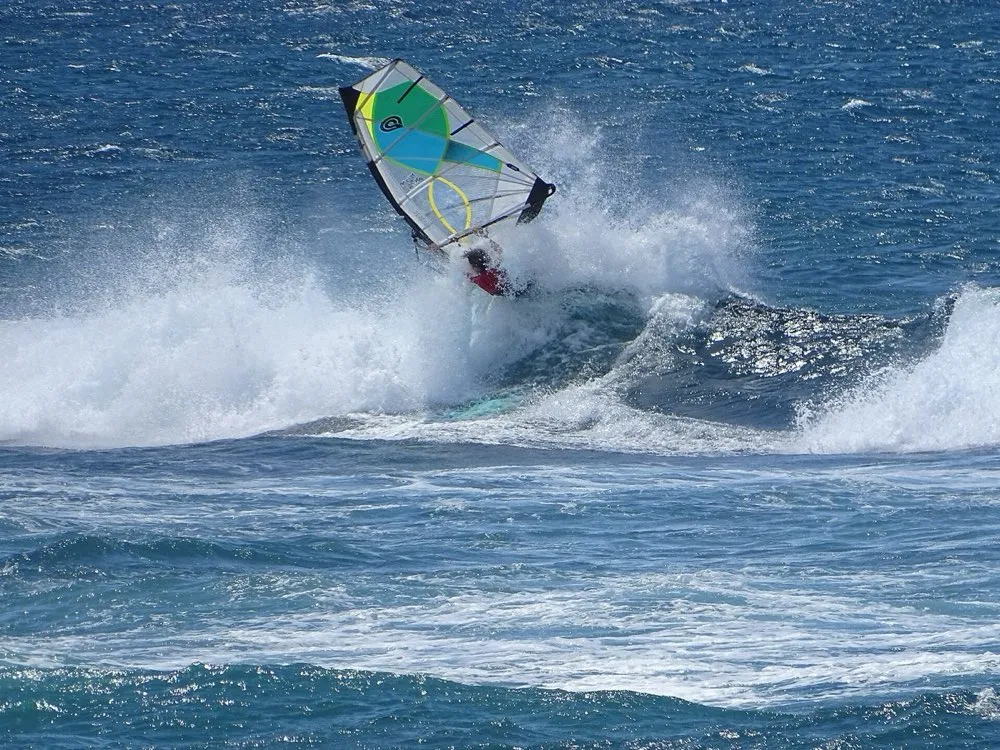
| Coordinates | Maliko Gulch → Kahului Harbor (or Kanaha Beach Park), north shore of Maui, Hawaii |
| Wind | NE trades, commonly 25–45 kt in season, best Apr–Sep; 20–25 kt recommended for a first run (boardridingmaui.com) |
| Water | Open-ocean channel with no shelter; best days pair with 3–8 ft N/NE swell; reefs near the takeouts |
| Relaunch room | The entire run is deep open water; alternate takeouts at Kanaha (~2/3 distance) and Sugar Cove (summer, no north swell only) |
| Rescue | No organized rescue on the course: partner or chase support mandatory; VHF or waterproof phone (cell coverage gaps mid-run) |
| Rules | Kahului Harbor federal security zone: no inner harbor, stay 100+ yd off ships; fines cited at $25,000–$32,500 per violation |
| Level | Expert, open ocean: a commitment run with limited safe bailouts |
Why Maliko is the benchmark
Every downwind run on earth gets compared to this one. Maliko Gulch → Kahului Harbor is ~9 mi (14.5 km) of open Pacific along Maui’s north shore, and parawing downwinding was invented on it: BRM, founded by Greg Drexler, released the Maliko V1 on August 21, 2024 and named it after the run. The design exists for this line, and the line rewards the single-stow format it created. Deploy in the gulch. Get up on foil, stash the parawing, ride the bump train to the harbor without redeploying once.
The bumps are the reason. NE trades funnel and accelerate along the island, commonly 25–45 kt in season, over a fetch long enough to organize the swell into what locals describe as a conveyor belt of rolling bumps you can glide on for miles with barely a pump.
Launch, line and takeouts
You launch at Maliko Gulch. Limited dirt parking, a rocky concrete ramp, surge. The crux is the exit: stay hard right past the rocks to clear the Turtle Cove hazard, then give Ho’okipa and Spartan’s Reef a wide berth. After that it is open channel with no shelter until the finish at Kahului Harbor (Hawaiian Canoe Club) or Kanaha Beach Park.
Know both bailouts before you start. Kanaha sits at roughly two-thirds distance; Sugar Cove works in summer only, and only with no north swell. Reefs sit near the takeouts, so get local guidance on the finish line before your first run rather than after it.
For pace reference: at the first Maui downwind foil race in 2018, SUP-foil times were ~48–60 min; elite foilers are now well under 40 min. On a good day a parawinger on foil is doing a near-continuous glide, not a grind.
Wind and season
Best months are April through September, when the NE trades run daily at a common 25–45 kt. The recommended window for a first Maliko is 20–25 kt paired with 3–8 ft of north/NE swell. Wind can and does drop mid-run, which is why the local convention is to size the parawing +1 for range insurance, with ~2.9 m a common size on Maui. Caught underpowered in the channel, you are either pumping to a bailout or into a long drift and self-rescue. Take the size call seriously.
Shuttle logistics
One way, no loop. Maliko Shuttle, running since 2010 and long billed as the island’s only dedicated downwind shuttle (Men’s Journal profile), picks up at Kahului Harbor and Lower Kanaha and drops at the gulch, claiming ~40% time savings over a DIY two-car drop. Its website was unreachable at the time of writing, so confirm it is still operating before you build a trip around it. Gear and lessons: Second Wind Maui, Action Sports Maui, Hi-Tech. Read Safe to Swim Hawaii’s Maliko Bay page for the launch itself.
Rules and real hazards
The finish is the regulatory trap. Kahului Harbor sits inside a U.S. federal security zone. Do not enter the inner harbor. Stay 100+ yards from cruise ships, fuel barges and military vessels, and stay out of the turning basin when a ship is moving. The moving exclusion zone extends 100 yards around a vessel within three nautical miles of the harbor mouth. Local paddling advocates cite fines of $25,000 per infraction (mauipaddle.com); U.S. Coast Guard harbor-security releases in Hawaii cite civil penalties up to $32,500 per violation, plus possible criminal penalties. Foiling has also faced local pressure to be removed from the harbor. Do not be the incident that tips it.
On the water: no shelter, cell coverage gaps mid-channel, and a buddy who usually has to finish the run before anyone can triage a rescue. Carry a VHF or waterproof phone, wear a PFD, file a float plan, never go solo. And if a stashed parawing turns into a tangle out there, you want deep-water repack drilled cold before you ever launch here.
Community and events
No downwind culture runs deeper. Paddle Imua (15th annual, July 12, 2026, Maliko Gulch → Kanaha) benefits Camp Imua and now runs a parawing division (discoverimua.com); it opens the Koa Kai Crown foil series linking Maui, Molokai and Oahu. Maliko also feeds Maui2Molokai (~27 mi) and serves as the reference point for Molokai2Oahu.
Who this run is for
Riders who can already complete a full run single-stow, make open-ocean judgment calls, and self-rescue without drama. If that is you, this is the pilgrimage. If not yet, build distance somewhere forgiving first: the Columbia Gorge run has the easiest shuttle laps anywhere, and Le Morne’s downwinders offer warm-water miles. More runs in the spots directory.
FAQ
How long is the Maliko Run?
Commonly cited at ~9 mi (14.5 km) from Maliko Gulch to Kahului Harbor; some sources say 9.6–10 mi depending on the exact line and takeout. For pace context, SUP-foil race times have dropped from ~48–60 min at the first Maui downwind foil race in 2018 to well under 40 min for elite foilers.
Can you do the Maliko Run on a parawing?
Yes. This is the birthplace of parawing downwinding. BRM named the Maliko V1, the single-stow parawing that created the sport (released August 21, 2024), after this run, and Paddle Imua now includes a parawing division. The standard line is deploy at the gulch, get on foil, stash, and glide the whole way.
Is the Maliko Run dangerous?
It is an expert open-ocean run: no shelter, a rocky surge-prone launch, the Turtle Cove hazard exiting the gulch, reefs near the takeouts, and cell coverage gaps mid-channel. The finish sits next to a federal security zone with fines cited at $25,000–$32,500 per violation. Never ride it without a partner or chase support and a VHF.
How do you get back to the start of the Maliko Run?
It is a one-way run, so you need a shuttle. Maliko Shuttle (running since 2010, long billed as Maui's only dedicated downwind shuttle) picks up at Kahului Harbor and Lower Kanaha and drops at Maliko Gulch, claiming to cut ~40% off DIY car-drop time. Confirm it is still operating before you count on it. Otherwise it is a classic two-car drop.